Understand how contract termination operates under Bahraini law when one party fails to fulfil its contractual obligations. This article examines judicial and contractual termination, the legal requirements for compensation, and the rights arising from the termination of contractual relationships.
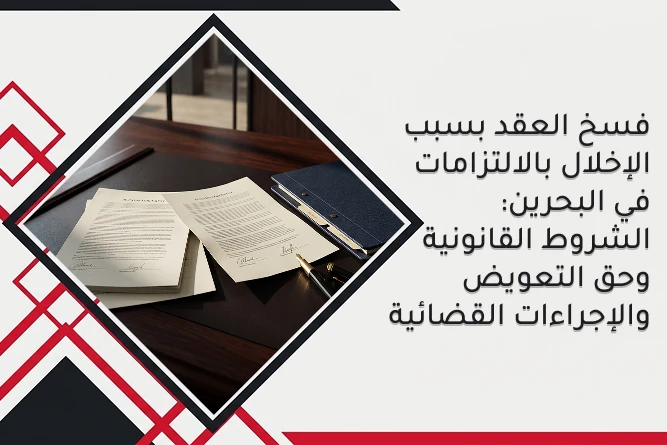
Contract Termination Due to Breach in Bahrain: Legal Requirements, Compensation Rights, and Judicial Procedures
Table of Content
Contracts are among the most important legal instruments governing relationships between individuals and businesses. They establish mutual obligations that each contracting party must fulfil in accordance with the agreed terms and applicable legal provisions.
The general rules governing contracts and obligations in Bahrain are set out in the Civil Code promulgated by Legislative Decree No. (19) of 2001. These provisions also regulate the legal consequences arising when one contracting party fails to perform its contractual obligations.
Contract termination for breach generally refers to the ending of a contractual relationship because one party has failed to perform an obligation for which it is responsible, subject to the applicable statutory or contractual requirements.
Contractual breaches may take several forms, including:
-
Failure to pay outstanding amounts within the agreed deadlines.
-
Failure to deliver goods or products in accordance with specified requirements.
-
Delays in completing works or providing services without an acceptable justification.
-
Failure to comply with agreed project schedules or performance milestones.
-
Providing services or carrying out works that do not meet contractual specifications.
-
Refusing to perform an essential obligation affecting the purpose of the agreement.
Not every contractual breach automatically gives rise to a right to terminate the agreement. The nature of the breached obligation, the seriousness of the breach, and its impact on the other party's rights must be examined.
It is also important to distinguish termination as a remedy for non-performance from contractual termination under a specific clause granting one party the right to end the agreement in defined circumstances, which may not necessarily involve a breach by the other party.
The applicable legal consequences depend on the type of contract, its nature, its duration, and the provisions agreed upon by the contracting parties.
The right to terminate a contract depends on several legal requirements, which vary according to the nature of the contractual relationship and the provisions governing it.
Important considerations include the existence of an obligation that has become due for performance, the failure of one party to fulfil that obligation, and the impact of such failure on the contractual relationship.
First: Judicial Termination
Judicial termination occurs when the affected party applies to the competent court for termination of the contract because the other party has failed to fulfil its obligations.
In such circumstances, the court examines the agreement, the submitted documents, the nature of the relevant obligation, and the circumstances surrounding the alleged breach.
The court may also consider the seriousness of the breach and whether the defendant has performed, or legally offered to perform, their contractual obligations.
Filing a request for termination does not automatically require the court to grant it. The outcome depends on the applicable legal provisions and the facts presented before the court.
Second: Contractual Termination
A contract may contain a clause specifying the circumstances in which one party is entitled to terminate the agreement if the other party breaches its obligations.
This is commonly referred to as an express termination or resolutory clause. Its purpose is to establish the consequences of non-performance and clarify the procedures that must be followed when ending the contractual relationship.
Examples of circumstances that may be covered by such a clause include:
-
Failure to make payments within a specified period.
-
Repeated violations of service delivery requirements.
-
Failure to perform essential contractual obligations after receiving notice.
-
Breaches of confidentiality or information protection obligations.
-
Assigning the contract or transferring obligations without the required consent.
However, including a general termination provision does not guarantee that it can be enforced in every circumstance. The wording of the clause, the procedure for invoking it, and its compliance with mandatory legal provisions must all be examined.
Third: Formal Notice Before Seeking Termination
Depending on the type of contract, applicable legal provisions, and agreed terms, serving a formal notice or demand for performance may be necessary before requesting termination or invoking certain legal consequences.
The purpose of such notice is to establish that the affected party formally requested performance and, where legally or contractually required, provided the other party with an opportunity to remedy the breach within a specified period.
Accordingly, parties should retain evidence of sending and receiving notices, clearly identifying the unperformed obligation and the deadline given for remedying the breach.
A contractual breach may result in financial or commercial losses for the affected party. Consequently, the right to seek relief is not necessarily limited to contract termination and may also include a claim for compensation resulting from non-performance or delayed performance.
Compensation is governed by the general rules of contractual liability under Bahraini civil law, subject to the applicable requirements for establishing entitlement based on the nature of the obligation and the breach.
The main factors considered when assessing a compensation claim include:
-
The occurrence of a contractual breach attributable to the responsible party.
-
The existence of actual damage suffered by the affected party.
-
A causal connection between the breach and the damage.
-
The absence of a legally recognised ground that exempts the responsible party from liability, where the applicable exemption requirements are satisfied.
Damages may include direct financial losses incurred as a result of the breach, together with any other legally recoverable losses established to have resulted from the wrongful conduct.
Agreed Compensation and Liquidated Damages Clauses
The contracting parties may agree in advance on a specific amount payable if either party fails to fulfil its contractual obligations. This arrangement is commonly known as an agreed compensation or liquidated damages clause.
Such clauses are frequently included in commercial agreements, construction contracts, and service agreements to establish the anticipated compensation for non-performance or delay.
However, the inclusion of a liquidated damages clause does not necessarily mean that the agreed amount becomes automatically payable in every circumstance. Claims under such provisions remain subject to the legal rules governing agreed compensation, and the court may review entitlement in accordance with the applicable statutory requirements.
A party may also be entitled to claim additional damages where the relevant legal conditions are satisfied.
Legal Consequences of Contract Termination
Depending on the nature of the agreement and the applicable legal provisions, termination may bring future contractual obligations to an end and may give rise to obligations to return received benefits or settle amounts and rights arising from performance before termination.
In reciprocal contracts, termination may result in the parties being restored, where possible, to the position they occupied before entering into the agreement. Where restoration is not possible, compensation may be considered in accordance with the applicable legal rules.
However, in continuing contracts or agreements involving services or benefits that cannot practically be returned, the consequences may differ depending on the nature of the contract, the period of performance, and the rights that arose during its validity.
For this reason, determining the financial and legal consequences of termination requires a review of the contract, the obligations already performed, and the payments made.
When one party breaches its contractual obligations, the affected party should take appropriate steps to protect its rights and avoid actions that could negatively affect its legal position.
The process should begin with a review of the agreement to identify the parties' obligations, termination and cancellation provisions, notice requirements, and any agreed deadlines.
The main practical steps include:
1. Reviewing the Contract and Identifying the Breached Obligation
The affected party should identify the obligation that has not been performed, determine whether the breach concerns an essential or secondary obligation, and assess its impact on the main purpose of the contract.
2. Collecting Evidence and Supporting Documents
The original agreement, amendments, invoices, correspondence, payment records, delivery reports, and any other documents establishing the breach and resulting damages should be retained.
3. Serving a Formal Legal Notice Where Necessary
It may be necessary to serve a formal notice requiring the other party to perform its obligations within the applicable statutory or contractual period. Evidence of receipt should be retained.
4. Negotiation or Judicial Proceedings
The parties may attempt to resolve the dispute amicably where appropriate. If no agreement can be reached, the affected party may initiate the appropriate proceedings before the competent court, subject to any valid and applicable arbitration agreement.
The Role of a Lawyer in Contract Termination Disputes
Contract termination disputes require legal expertise in interpreting contractual provisions, identifying the parties' obligations, and assessing the consequences of non-performance.
A lawyer specialising in contracts and civil law in Bahrain can provide assistance with:
-
Reviewing the contract and identifying termination provisions.
-
Assessing the legal position of the affected party.
-
Determining whether compensation may be claimed for the resulting damages.
-
Preparing formal notices and legal notifications.
-
Drafting legal claims and written submissions.
-
Negotiating with the other party to achieve a settlement.
-
Filing contract termination and compensation claims.
-
Following up on the enforcement of judicial judgments.
Obtaining legal advice at an early stage helps prevent improper contract termination, reduce financial exposure, and protect the rights arising from contractual relationships.