A defense memorandum is a legal document that the defendant or his lawyer submits in reply to the claim statement filed by the plaintiff. Its goal is to answer the plaintiff’s allegations and to show the evidence that supports the defendant’s position.
Under the Civil and Commercial Procedure Law (Decree-Law 12 of 1971), the defendant may deposit a defense memorandum with the court clerk within ten days from the day the claim statement is served on him, together with the documents he wants to rely on (Article 25). The plaintiff then has ten days to reply, and the defendant may also state his defense and present evidence at the hearing (Article 80).
A defense memorandum usually includes these main parts:
- The names of the parties, the case number and the competent court.
- The facts of the case.
- The defendant’s position on the amount claimed.
- The formal defenses and the substantive defenses.
- The documents and the evidence.
- The closing requests.
When you face a financial claim, a sound legal defense is the key to protecting your rights. A defense memorandum for a financial claim in Bahrain is the main written document that shows the defendant’s position before the court, so it must be drafted with care.
In this article, we explain how to prepare an effective memorandum, which defenses you can raise, and how the court procedure works.
Below is a general model of a defense memorandum for a financial claim in Bahrain, prepared by lawyers. Adapt it to the facts and documents of your case, and ask a lawyer to review it before you file it.
| Part |
What to write |
| To |
The Honorable President of the Court. |
| Submitted by |
(Name of the defendant), against the plaintiff (name of the plaintiff), in the case (case number). |
| Subject |
A defense memorandum in a financial claim. |
| First: Facts |
The plaintiff claims the amount of (amount) on the ground that (summary of the allegations in the claim statement). |
| Second: Legal defenses |
Lack of jurisdiction, if the court is not the competent one. Defects in the claim statement. No contract or document that proves the debt. Limitation, or the end of the right to claim. The plaintiff did not perform his own obligations, so he has no right to demand payment. |
| Third: Requests |
Dismiss the claim because it has no sound legal basis, and order the plaintiff to bear the expenses and the lawyer’s fees. |
| Closing |
Respectfully submitted. Date: (date). Name and signature of the lawyer or the defendant. |
These are the main defenses to consider when you prepare a defense memorandum for a financial claim in Bahrain.
Formal Defenses
- Lack of jurisdiction: if the claim is filed in the wrong court, the court declares that it has no jurisdiction and sends the case to the competent court (Article 28).
- Request to dismiss the claim: after being served, the defendant may ask the court at any time to dismiss the claim because the case was already decided, because the court has no jurisdiction, or because the limitation period has passed (Article 30).
- Inadmissible claim: the defendant may object that the plaintiff has no capacity, standing or interest, at any stage of the case (Article 31).
- Defects in the claim statement: the plaintiff must state the exact amount claimed and the grounds clearly (Article 23), and the court may give him time to fix any defect (Article 27).
Substantive Defenses
- No proof of the debt: the creditor must prove the obligation, and the debtor must prove that he is discharged from it (Article 1 of the Evidence Law).
- Payment: attach receipts, bank transfers and messages that show the amount was paid or settled.
- Limitation: under the Civil Code, a personal claim is not heard after fifteen years, and periodic rights such as rent, salaries and wages lapse after five years (Articles 365 and 366).
- Non-performance by the plaintiff: the plaintiff did not perform his own obligations under the contract.
- Counterclaim: the defendant may ask for judicial set-off, or for compensation for harm caused by the claim, in a counterclaim (Articles 67 and 68).
Knowing the steps helps the defendant plan the defense on time. To see the plaintiff’s side, read our guide on how to file a financial claim in Bahrain.
1. The Competent Court
The competent court depends on the value and the nature of the claim, and the courts have different value limits. Ask the court clerk or your lawyer for the current limit before you rely on any figure.
2. The Claim Statement
The plaintiff prepares the claim statement with the parties’ details, the exact amount, the grounds and the requests. He files it with the claims registration section and pays the full fee (Articles 23 and 24).
3. Service on the Defendant
On the day after the filing, the clerk serves the defendant with a copy of the claim statement (Article 25).
4. The Defendant’s Reply
The defendant deposits the defense memorandum with the documents within ten days. This is the best time to raise every defense, because the memorandum shows the court your full position.
5. Hearings and Pleading
After the periods end, the clerk sets a hearing (Article 26). At the hearing, the plaintiff states his claim and evidence first, then the defendant states his defense and evidence (Article 80).
6. The Judgment
After the pleading and the study of the evidence, the court either orders the defendant to pay the amount or dismisses the claim.
7. Enforcement
If the judgment is for the plaintiff, he may ask the enforcement court to enforce it under the Enforcement Law (Decree-Law 22 of 2021).
A lawyer is essential in preparing a defense memorandum for a financial claim in Bahrain, because he helps the defendant build a strong defense based on the law and the available evidence. A lawyer who specializes in financial cases usually does the following:
- Case analysis: he studies the case file and the plaintiff’s documents, then chooses the best defense strategy.
- Drafting the memorandum: he writes the formal and substantive defenses and attaches the documents that prove the plaintiff has no right to the amount.
- Representation: he attends the hearings for the defendant and pleads the case. The defendant must give him a special authorization to admit the claimed right or to settle the dispute (Article 43).
- Friendly settlement: he may negotiate a settlement outside court to avoid long procedures and extra costs.
- Appeal: if the judgment is against the defendant, he appeals it before the court of appeal within the legal time limit, based on legal errors or new facts.
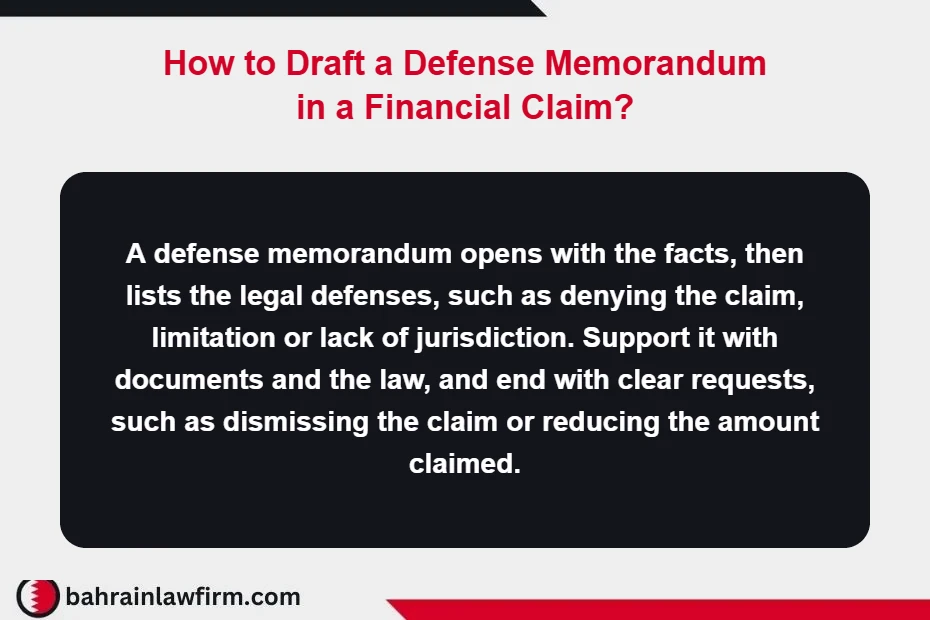
How do you draft a defense memorandum in a financial claim?
A defense memorandum starts with an introduction that explains the facts, followed by the legal defenses, such as denying the claim, limitation or lack of jurisdiction. It is best supported with documents and the applicable law, and it should end with clear requests, such as dismissing the claim or reducing the amount claimed.
When must the defendant submit the defense memorandum?
The Civil and Commercial Procedure Law gives the defendant ten days from the service of the claim statement to deposit his memorandum with the court clerk (Article 25). The defendant may also state his defense at the hearing, so check the dates in your summons with your lawyer.
Can the defendant file a counterclaim in the same case?
Yes. The defendant may ask for judicial set-off, or for compensation for harm caused by the claim or by a step in it, by filing a counterclaim with the procedures of a claim statement (Articles 67 and 68).
Can I raise limitation as a defense?
Yes. The defendant may ask the court to dismiss the claim because the limitation period has passed (Article 30). The Civil Code sets fifteen years for a personal claim and five years for rent, salaries and wages (Articles 365 and 366), so check the date the debt became due and any interruption of the period with your lawyer.